2025 – 2026
Case study 09 · 2024 – 2026 · venture design · Define to DeliverFruityard: a venture studio that tests before it builds
New founders rarely get proper discovery before they build. The overview: why a studio and an academy, what's built, and what I changed. The two services each have their own case below.
Read the case study → · 5-minute read
Case study 09a · 2024 – 2026 · service design · Define and DevelopFruityard Studio: selling the test before the build
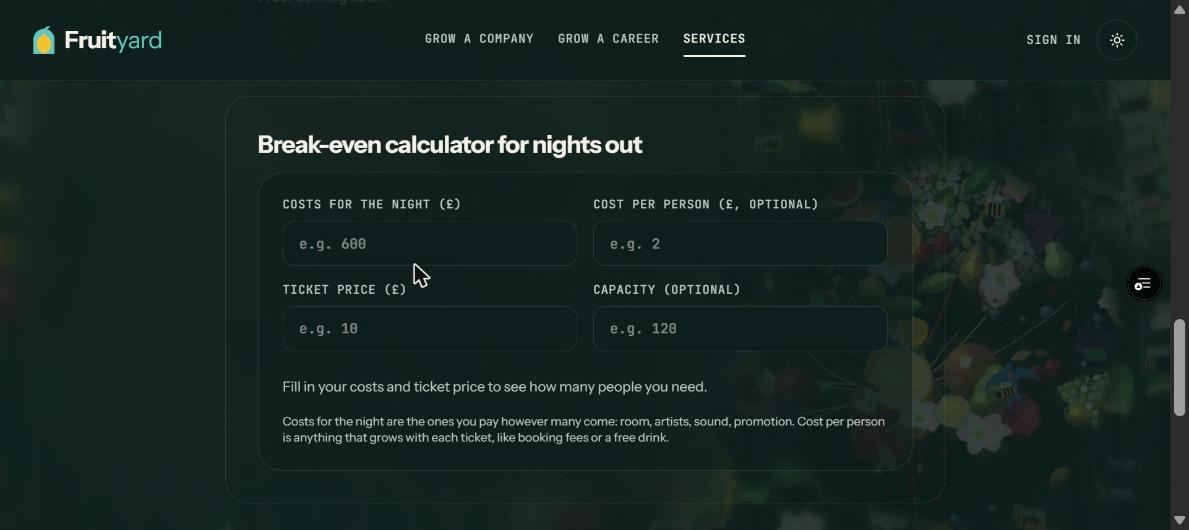
Five services as small cases: Discovery, ad prototypes, free planning tools, the Room Fit Review and the later stages. Includes a working demo of the new break-even calculator.
Read the case study → · 5-minute read · Try the calculator →
Case study 09b · Oct – Nov 2026 · learning design · DevelopFruityard Academy: from seven course ideas to two pilots
How the courses were ideated from the roles in a real client project, which five I held back, and why two became pilots.
Read the case study → · 4-minute read
Case study 09c · Oct – Nov 2026 · learning and service design · DeliverCreative Director course: an ad competition that asks for evidence
A student ad competition for a real client, redesigned so teams prototype with AI, test on 10+ real people and pitch what they learned. Testing carries as many marks as the idea.
Read the case study → · 5-minute read
Case study 09d · Nov 2026 · learning and service design · DevelopUX Researcher course: paid research on a problem I'd already found
My student housing study becomes a course: postgraduates learn the method on it, then run paid, supervised reviews of student housing. Demand is being tested with seven audiences first.
Read the case study → · 5-minute read
Case study 09e · Oct – Nov 2026 · service design · DevelopThe studio's first sector: music businesses
Labels, promoters, record shops and new founders, each with a free tool, a self-serve plan and a full Discovery. Housing and games are the next sector cases.
Read the case study → · 4-minute read
Case study 09f · Nov 2026 · service design · DefineThe studio's next sector: small games studios
Test a game's world, characters and adverts with players before paying for production. Built from my Skate. research, starting in Bristol.
Read the case study → · 4-minute read
Case study 08 · 2025 – 2026 · innovation research · Discover and DefineSkate.: when fans built what was promised
EA rebuilt a cult skate series as a free-to-play live service. A year in, players praise the skating and reject what's built around it, and a fan mod passed 350,000 downloads in days. A scorecard of how EA manages innovation, and five changes I'd make.
Read the case study → · 5-minute read
Case study 07b · 2026 · prototyping and testing · solo · DevelopNature on campus, a year on: running the redesigned test
Each change answers a finding from the team test: one bike ride, foraging and dyeing the same day, real samples and a field guide for Cardiff.
Read the case study → · 3-minute read
Case study 07a · Nov 2025 · prototyping and testing · Develop and DeliverNature on campus: prototype and test
My idea, upcycling clothes with foraged dyes, was prototyped and tested with students. Then delivery broke down.
Read the case study → · 5-minute read
Case study 06 · Oct–Nov 2025 · ideation · DevelopWomen in sport: ideating from a handover
An agency team takes over a client's research on why girls drop out of sport. The vote and the evidence picked different ideas, the research had a gap, and the honest answer to the client was "not ready to build".
Read the case study → · 5-minute read
Case study 05b · Nov 2026 · service review · solo · DefineA year on: what student housing booking websites show
I checked five providers' booking pages against the six things students said they needed. None covered all six, and room fit was weakest everywhere.
Read the case study → · 3-minute read
Case study 05a · 2025 · user research · Discover and DefineFinding student housing from abroad
How international postgraduates find a room before they arrive in Bristol. Stress peaks at 6.0 out of 10 when they sign for a room they haven't seen. Includes a possible critical finding our analysis lost, and how I'd fix the process.
Read the case study → · 5-minute read
2022 – 2023
Case study 04 · Dec 2022 – Mar 2023 · discovery research · Define and DevelopSoundCloud: charts that let niches be found
There was no grime chart. I proposed a small, testable change: let creators and fans propose and vote on new subgenre charts, so niche artists and their fans can find each other.
Read the case study → · 5-minute read
Case study 03 · 2022 – 2023 · discovery research · Discover and DefineSpotify: why a good band can't be found
I followed one psych-rock band through every route a new listener could use to find them. Every free route was a dead end, and the paid route wasn't what I first thought.
Read the case study → · 5-minute read
2018 – 2022
Case study 02c · 2020 – 2022 · venture design · DevelopA creator marketplace, part 3: a marketplace that makes only what sells
A crowdsourcing model where fans help design clothes before they're made, developed without funding in Lisbon. In 2022 it moved into music.
Read the case study → · 4-minute read
Case study 02b · 2019 – 2021 · venture design · Define and DevelopA creator marketplace, part 2: a demonstrator I built alone
My final-year demonstrator, run again when I repeated the year I spent away in Lisbon. Follow-first community building beat two paid promotions combined.
Read the case study → · 3-minute read
Case study 02a · 2018 – 2020 · discovery research · DiscoverA creator marketplace, part 1: curators were already running marketplaces
A third-year group project that found Instagram curator accounts had a marketplace's audience but no way to sell.
Read the case study → · 3-minute read
2014 – 2020
Case study 01 · c. 2019 · marketing strategy · Discover and DefineIsla Bikes: a bike that grows with the child
A marketing plan for renting or part-exchanging kids' bikes as they grow: the competition, the cash-flow risk inside a made-to-order business, and where shops and concierge services fit.
Read the case study → · 5-minute read
Engineering · 2015 – 2020 · electrical and electronic engineering with innovationEngineering: building hardware and software from the ground up
Before design and research, I trained as an electrical and electronic engineer. I learned to build both halves of a product: the circuit and the code that runs it.
Hardware
- A wireless link, from theory to working kit. I designed and built a transducer and receiver system myself, the circuit plus the software to transmit and decode, proving a wireless communication design from first principles.
- A smart mirror (2016 hackathon, team of three). Built on Arduino and Raspberry Pi, it showed live weather and morning schedule reminders.
- Power electronics. A technical note on thyristor switching that placed our team second in the engineering lab (2018).
- Digital hardware in VHDL. Designed and tested a serial data receiver as a state machine, simulated in ModelSim.
- Circuit and digital-circuit labs throughout.
Software
- Low level to high. Assembly, C on Linux, C++, C#, Java and Python, plus VHDL for hardware.
- Human–computer interaction (2017/18). My first formal design unit, before the innovation work took over.
- The Wireless Orchestra (first-year project). Real-time software in C: I wrote a simple master–slave protocol of ASCII commands, sent over a wireless serial link, to conduct instrument notes across devices.
- Games as a way in. A sprite game to learn programming, then a game in Python.
- From one wireless link to networks. The orchestra led into units in communication systems, mobile communications, advanced mobile radio, broadband wireless, networking protocols, networked systems and applications, and coding theory (error checking): the plumbing behind every app I build now.
Why it matters now: I still build both halves. Today it's my own marketplace platform and Fruityard's tools, specified, reviewed and tested by me. Write-ups of the individual engineering projects will follow as I recover the files.
Case study 00 · Sep 2014 – Apr 2015 · hardware design · the whole loopWhere it started: a portable amplifier speaker
A college brief: solve a real problem with a circuit on a £20 budget. I chose my own problem, a phone too quiet to play music out and about, and designed, built and tested a battery-powered amplifier speaker.
Read the case study → · 5-minute read